
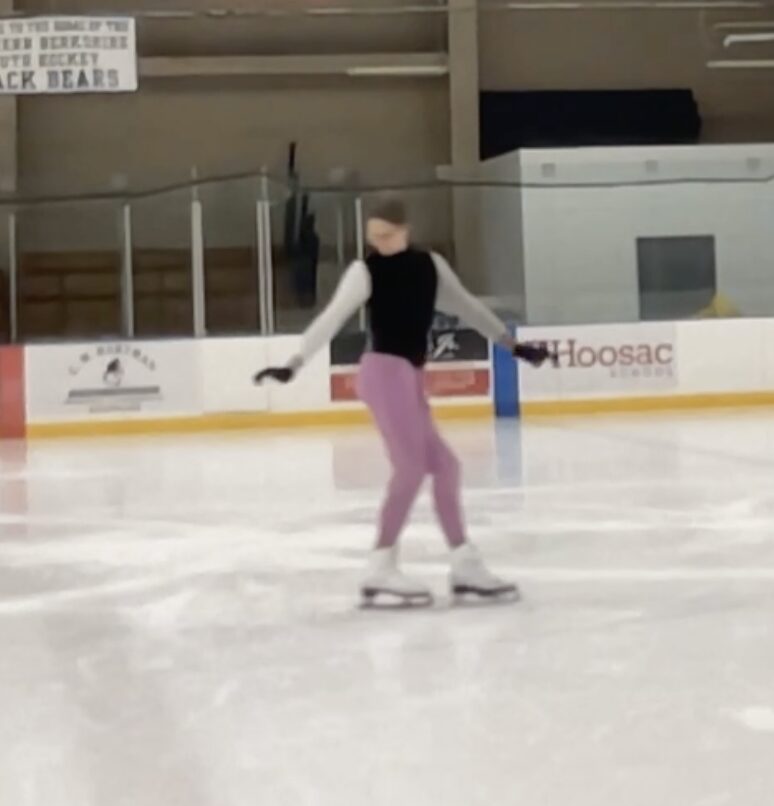
OK I got you with the clickbait. There’s a whole genre of “I trained like an Olympic Figure Skater” videos, typically they involve intense short-term beginners trying tricks with an expensive coach, but all they really accomplish is social media views.
More seriously, how can we set ourselves up for long-term success? I begin with the premise that students should be taught the same whether they have perceived “recreational” or “serious” goals. Hopefully we will learn more if we practice more (up to 6 days/wk); and in fact, our bodies forget what we’re doing if we practice less than 2-3 days / wk. But either way, movement art training is serious, and it is impossible to predict what one’s goals might evolve into. Over time progress builds commitment, which builds more progress. Conversely if we teach students poor technique for quick initial results — because they’re just “recreational” and they want to learn a trick — they risk getting frustrated and quitting.
Therefore, the first step in training like an Olympic figure skater is identifying an appropriate training regime that can propel us to the highest levels. Top professional ballet schools use well-documented curricula and pedagogy that has been proven over generations, with broad agreement between systems on how ballet training works. In contrast, the most common figure skating curriculum used in the United States today, USFSA Skating Skills, is clearly not sufficient to reach the top competition levels: compare Gold Skating Skill test videos with what we see in National competitors, and note that dedicated students frequently pass the last Skating Skill test around age 10. The justification for the Moves in the Field (now Skating Skills) curriculum in the 1990’s was never to create a better training system, but rather to make the system easier for the 99% of non-elite skaters: “U.S. Figure Skating President Hugh Graham pointed out that abolishing figures reduced a skater’s expenses by cutting the costs of coaching and ice time.” (Skating Magazine, Aug/Sep 2021). This has not actually cut the cost of coaching and ice time for skaters aiming for the top, but has instead made quality training less available for the 99%. Elite skating schools today maximize coaching and ice time, and teach whatever they think will get their students to the top. But now they keep it secret. For someone looking to Train Like and Olympic Figure Skater who is not already in an elite skating program, Skating Skills is not a viable option.
It was not always like this. Since its inception in the 1890’s, the sport of figure skating had its own well-established training curriculum: the set of ISU figures, commonly known as “compulsory” or “school” figures, arranged in graded tests labeled “preliminary” and 1 through 8. When this set of figures was selected out of the hundreds of figures commonly practiced throughout the 19th century, they were chosen by pedagogues of the time as a “grammar of skating,” i.e. a program for students to work through and learn how to figure skate. Over the next 100 years, ISU figures proved their value as a training methodology for generations of figure skaters. Here is what Janet Lynn had to say about them in 2011. (Note that Janet Lynn was cited as a reason to devalue figures in the 1970’s because she was not winning competitions at the time in spite of her world class free skating skills):
This is in fact historically how most figure skaters trained. So if we want to skate like Olympic figure skaters from the 1990’s, known today as the “Golden Age of Figure Skating,” the figures curriculum would be a good place to start. Ultimately we want to develop our own personal style of free skating, noting that the vocabulary of figure skating is far more vast and interesting than what garners points under IJS. And given the gymnastic quality and high injury rates of today’s competition figure skating, targeting an earlier style makes sense for most of us, especially anyone with an adult body. So with the 1990’s (or before) in mind, let’s look at what the celebrated coach Carlo Fassi had to say in 1980 (Skating with Carlo Fassi), on “What it Takes to Become a Serious Competitor”.
Let’s see how we can apply this advice in the 21st Century.
Two Hours a Day on Figures
The most fundamental need is a rink and skating sessions where we can practice figures. Before the 1990’s, this was done in the context of patch sessions and figure skating clubs. Patch sessions are a thing of the past, and “freestyle” sessions full of children of various abilities running their programs are not a good place to practice figures today. Mid-day public skating sessions, when school is in session, tend to be the best environment these days. Your mileage may vary. But even if there are 20 or more skaters on the ice, most of them circulate around the outside, leaving the center free to practice large figures. Added bonus, public skating sessions cost little. Another possibility, at least in theory, would be to use part of the ice in a Learn to Skate session. If none of those are possible, the best bet is a freestyle session that is as empty as possible.
An infrastructure to support the figures curriculum is also needed. World Figure Sport provides this in a multi-pronged approach:
- A comprehensive figure artwork training curriculum. It is similar to the ISU curriculum at the lower levels, but contains additional knowledge and skills that are essential to figure artwork but were abandoned in the ISU curriculum in 1897.
- Examination services for the curriculum, providing students with consistent standards of achievement.
- Online off-ice skating technique classes, allowing students to begin learning and practicing figure skating technique even if they do not have resources locally.
- An in-person teacher who is expert in the ISU figures is also essential beyond the beginner level. World Figure Sport may be able to help find such a teacher. If all else fails, virtual lessons on-ice would be the next best thing.
Four to Six Lessons a Week
.”..divided evenly between figures and free skating.” These are half-hour lessons, so he is recommending 60-90 minutes per week of figure lessons. This is consistent with common practice for serious music students. Note the contrast with today’s recommendation of 30-50% of on-ice time being coached, which Mr. Fassi also argued against in 1980. Independent practice is a critical component to learning through experimentation with our bodies. Each figure is a puzzle to be solved, and there is value in working on our own to find the solution. In my ballet education, we learned how to think about human movement and train our own bodies, and Mr. Fassi also mentions the importance of students learning to train themselves. There is also value in being directed toward the most efficient solution by someone who has already solved it.
What about Free Skating?
Fassi recommends 1 hour/day of free skating: typically, students would practice 2 hours of figures before school and 1 hour of free skating after school. This kind of schedule may not be practical for adults today. But actual Olympic figure skaters go to frequent competitions, which you might not have time to do, so less time needs to be spent learning and running programs. Figures are your technical basis. When in doubt, free skating time should be sacrificed for figures time, allowing for the continued technical development even if you do not have 3 hours/day available. It is also important to work up to a training schedule gradually: when I began I could not last more than 45 minutes on the ice.
In my case, I barely free skated at all for the first 18 months. What’s the point, if you cannot yet balance on an edge? And then one day, almost out of nowhere, I began skating with speed and power, my body applying what it had learned. Maybe for 10 minutes. Free skating is more dangerous than figures and requires adequate supervision to ensure safety. Beyond that, the content of free skating training depends entirely on the style of free skating the student wishes to pursue and develop (more on that below).
Classes in Ballet or Modern Dance
Skaters frequently mention the importance of “off-ice” training, but rarely do they explain what it is supposed to accomplish, or why, and hence the recommended content varies widely. A quick survey reveals that non-elite “off-ice” recommendations typically revolve around emulating jumps on the floor, or building strength / balance through athlete-type exercises, and they are done in sneakers. Although padded shoes like sneakers are necessary for jumping on concrete, the padding also makes it difficult to balance. That is why skates have a hard sole, and also why ballet dancers train without padded soles. To me, the ubiquitous use of sneakers therefore suggest a lack of deep understanding. (Note that jumping on concrete floors is NOT recommended without padded soles).
In contrast, elite skating schools today typically include ballet training, a recommendation that was developed through Soviet success in figure skating and has changed remarkably little since Carlo Fassi’s time. Therefore, if we wish to train like an Olympic figure skater, we should find time for two ballet classes per week! Luckily, quality ballet training is more readily available than quality figure skating: look for a ballet-only school with 90-minute classes and at least 3 or more studios, providing a program of 5-6 classes/wk for the advanced students. I also recommend the services of Face the Barre, including the Ultimate Beginner Ballet Course: it explains things at a level of detail rarely addressed in most in-person adult beginner classes! They also have a weekly Zoom class you can join from your own home!
Elite skating schools frequently provide one-hour “ballet for skater” classes. Usually the photos I see don’t even look like a ballet class: students might be wearing socks instead of ballet slippers, they are doing things that are not part of ballet training, and they just don’t hold themselves like ballet dancers. These classes might fit well into ice rink time slots and may actually provide skaters what they need. But as a ballet dancer, I cannot recommend them. Ballet is not just another body conditioning system listed on your local gym schedule: it is a beautiful athletic art with a deep history that engages our entire mind and body in ever-changing patterns of stillness and movement. If you step into a ballet class, I encourage you to engage fully in that world. For 90 minutes you are no longer a skater. You are now a dancer trying to make a beautiful arabesque, beautiful port de bras, and a quiet, stable pique balance. There are many connections between ballet movement and skating movement, which you can ponder after you finish class with reverence and a bow to the teacher. It comes together will come with time and patience.
In the interests of being specific on the how’s and why’s of our recommended off-ice training systems, I will try to explain why ballet training is a good use of any skater’s time:
- Every ballet movement originates from a single impulse, with all body parts moving in an integrated fashion. This develops beautiful, integrated upper body movement and port de bras. It is easy to spot skaters who have studied ballet from how they use their upper body. We all love to watch integrated movement, rather than coordinated movement.
- In ballet we balance on a patch the size of a silver dollar, in skating, we balance on a narrow blade. The two approaches to balance complement each other.
- In ballet we build awareness through movement of our body parts. We learn to sense and move them separately, and to stack them on top of each other for balance. Skating requires this awareness and fine control of our body parts, but it is not typically taught on-ice.
- In ballet we learn to bend our knees, push off the floor, and use our feet jumping and landing. Although skate boots are stiffer than ballet slippers, all those muscle patterns activate as well, with a skating push analogous to a ballet jump. Ballet teaches us how to cushion landings through our ankles and knees, a critically important aspect of large skating jumps. My feet are just as tired after skating, as after ballet.
- In ballet we learn to stand on our feet while lifting our arches. Too many skaters have flat feet, and there is no good reason for that. This is the level of ankle and foot control we need for stable outside and inside edges.
- In ballet we learn the principles of line, and how to develop beautiful lines from our toes through our heads and fingertips. This leads to beautiful free skating, most obviously exploited by John Curry. One example, our arabesque is critically important for skating spirals. Although some skaters have beautiful arabesque spiral positions, it is not taught carefully or systematically in skating training.
- In ballet (and figures), we train our body evenly on both sides. The more time we can spend training both sides evenly, the better off (and safer) we will be. Skaters are encouraged to study at least all single jumps and basic spins to both sides.
- In ballet we learn that warming up means activating our muscular patterns, not simply burning energy to generate heat. This translates to our skate training: warming up means getting our ankles working with finesse, getting our plié (knee bend) to its maximum, making sure we have clean solid edges and turns, etc.
- Ballet training happens entirely with music. From beginning to the end, we learn to listen to the music and move gracefully with it. This is far more comprehensive than training without music or rhythm, and then skating to program music a couple times an hour.
- In ballet class we learn many new combinations and exercises every week. This keeps our mind always active, learning and dancing different steps each time. When we are ready to learn a set piece of choreography, we are prepared to do that efficiently. Choreography is built out of movement patterns we have developed. We can train in a similar way on the ice.
- Ballet technique is simpler and in many ways less extreme than skating technique. We use turn-out but not turn-in. We turn out both sides together. We stabilize our body with turnout but not in all the other ways it’s done skating. We don’t have edges or glide. We only turn on the balls of our feet, not our heels. We have gentle epaulements, not the extreme twists required for figures. Ballet is not a magical way to learn skating without learning skating. But it is an excellent way to learn how to manage and control our bodies outside of the inherent complexities on ice. In ballet class we work on this standing in one place, holding onto the barre, where we can work on things carefully. That is not even possible with figures, let alone free skating. For that reason, for the beginning adult student I want to work with them in a ballet context before we even step onto the ice.
Elite skating programs also train skaters with exotic equipment such as motorized spinners and harnesses, and other specialized conditioning classes. Elite skaters today need triple and quadruple jumps, men in pair skating need extra upper body strength, etc. But unless there is a specific purpose for your desired outcomes, I would recommend just sticking with ballet training as an integrated all-around approach to developing your mind and body, and preparing it for skating.
Seven Days Per Week?
Mr. Fassi seems to suggest skaters practice 7 days per week, which is consistent with advice I have seen elsewhere. I cannot endorse such a schedule, as it is widely understood in the ballet world that our bodies need at least 1 day per week of rest. And rest means rest: no skating, no dance class, no gym, no weight training, etc. Maybe some gentle stretching. In the interest of longevity and injury prevention, I recommend training no more than 6 days per week.
How I Train
I train 2 hours/day, 5 days/week. In a 2-hour skating session, I warm up for a couple of minutes with the Single Grapevine. This classic two-foot figure is an excellent way to safely re-acclimate my body to balancing on blades, to work my spine through its full range of torsion, to work in second position plies, to work on moving my femurs through their full range of motion in my hip sockets, and to make sure I’m getting clean, silent edges. Then I typically spend the first hour on large figures, then 20 minutes on small figures, then 20 minutes on EDGE class-type free skating, and then 10 minutes on jumps and spins. My body is thoroughly warmed up by the time I get to jumps. In contrast, getting on the ice and spending an hour jumping is just asking for injury. This approximates the time-tested 90-minute ballet class consisting of 45 minutes of barre exercises, 30 minutes of center work, and 15 minutes of small jumps then large jumps, and has proven to be an effective way for me to make rapid technical progress.
The content of my free skate training is based on my free skate goals. I am inspired by John Curry and the skating art world he spawned. Therefore I draw from the training methods he pioneered, in particular the EDGE class for center work and related ice dance technique. Similar to enchainments (“combinations”) in ballet class, the enchainments in EDGE class develop our ability to put steps together in a fluid way, and to learn them quickly with mental flexibility. I also study and re-create the choreography of skating artists like John Curry and others, similar to a variations class in a ballet school. These choices are all driven by my goal as a skating artist: if my goal were to build competition programs, I would spend more time jumping and spinning.
I was lucky to find an excellent teacher with deep understanding of ISU figures and an ability to teach me in them efficiently. I take one 1 hour lesson per week with her, focused entirely on figures, the goals is maximum technical progress. Figures are the technical basis, whereas the proliferation of “test tracks” and “disciplines” is a way to keep people busy without building excellence. I also have an occasional free skating lesson, focusing on technical aspects of jumps and spins.
I am not currently learning or rehearsing choreography. I do commit to attending the World Figure Sport Figure & Fancy Skating Championship (WFS) each year, where I do need a free skate program. Too much choreography, performance and/or competitions at the wrong time can hinder development. I will begin choreography in the summer, which is appropriate for my current level and rate of improvement. I have plenty of past experience learning and performing choreography.
I attend one ballet class per week. That is less than Fassi recommends, but I previously trained ballet 6 days/wk. Ballet is how I trained my body and it is the home I always return to. After 5 days of skating, going through the liturgy of the ballet class re-sets my body and gets things working smoothly for the next week of intensive figure training (twisting my body into a pretzel). Ballet gently stretches and strengthens our bodies in ways that skating never could.
This schedule works for me for now. Will I need more time to make progress in the future? Probably, if I want to work on more choreography. But dance teaches us to live in the present, and then take care of the future in the future.
Other Training Curricula
Figures (whether ISU or World Figure Sport) are not the only documented figure training curriculum available. Peter Grütter, from the Skating School of Switzerland, developed the Steps and Turns curriculum, available for FREE through the ISU’s eRink learning platform. A look at the curriculum reveals it is similar to ISU Figures, although with less emphasis on high precision retracing. Coming out of this philosophy, the Skating School of Switzerland posts frequent “Step of the Month” videos on social media. Here Mr. Grütter discusses his teaching approach:
Because of the support services provided, the WFS curriculum is probably more accessible than Steps and Turns for most skaters today, at least most skaters in North America.