
The three turn may be the simplest of one-foot skating turns, but it hides a surprising amount of complexity. In fact, most materials online do not give it justice and draw patterns that are physically impossible, hence this article. For starters, let’s see what a three turn LOOKS like. Here is one by George Browne at Fresh Pond, a major proponent of figure skating from Cambridge, MA around the turn of the 20th Century; and on the right are some three turns of varying quality that I made in January 2026.
:
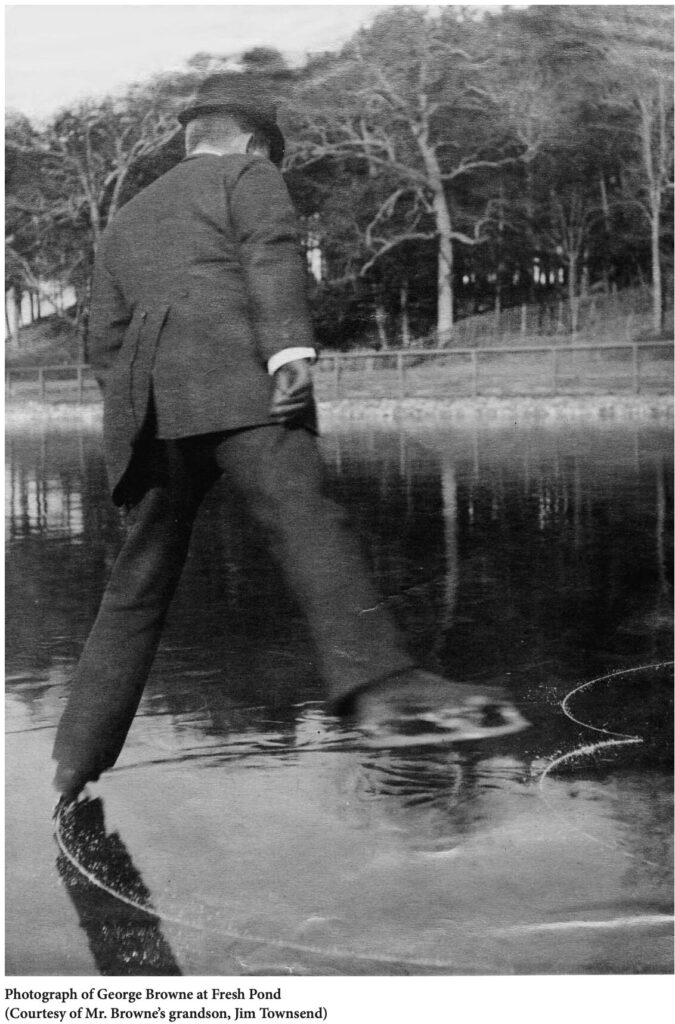
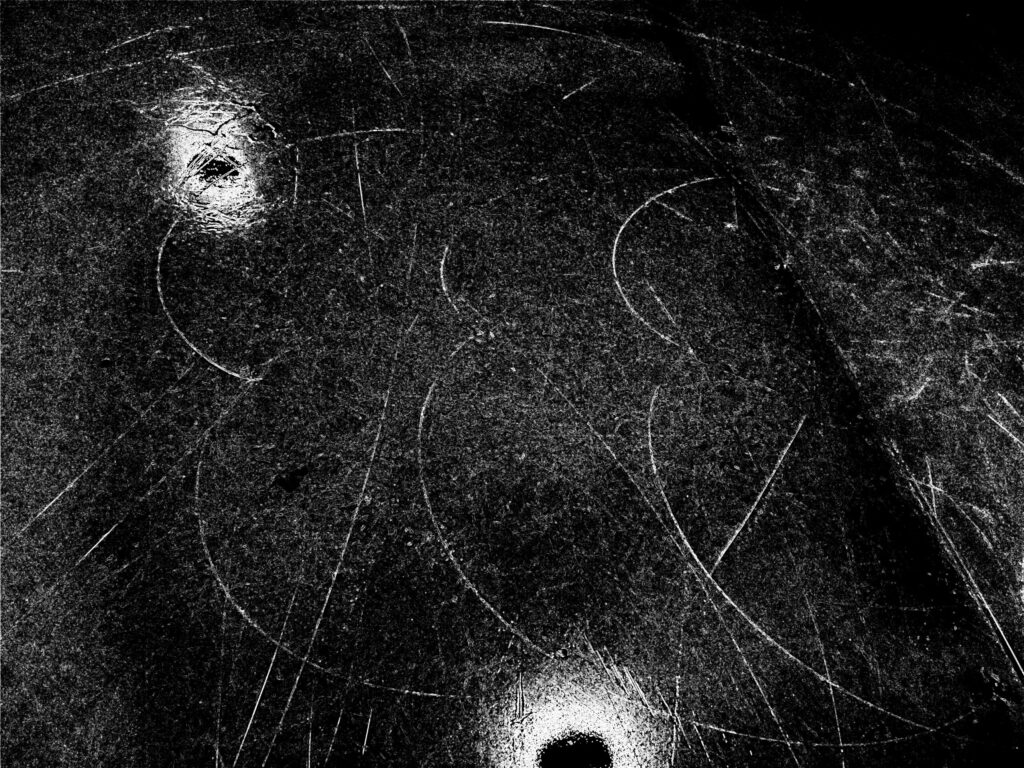
In both cases, these three turns are on loop size circles, about 2m in diameter. Notice how far the tracing diverts inside the circle at the apex of the three-turn, especially in Brown’s case (the better of the two examples). Here is an example of a three turn on a larger circle. It looks different because the circle is larger, but the distance from the circle to the apex of the three turn is still about 20cm. (This three turn is paired with a bracket to create a diamond):
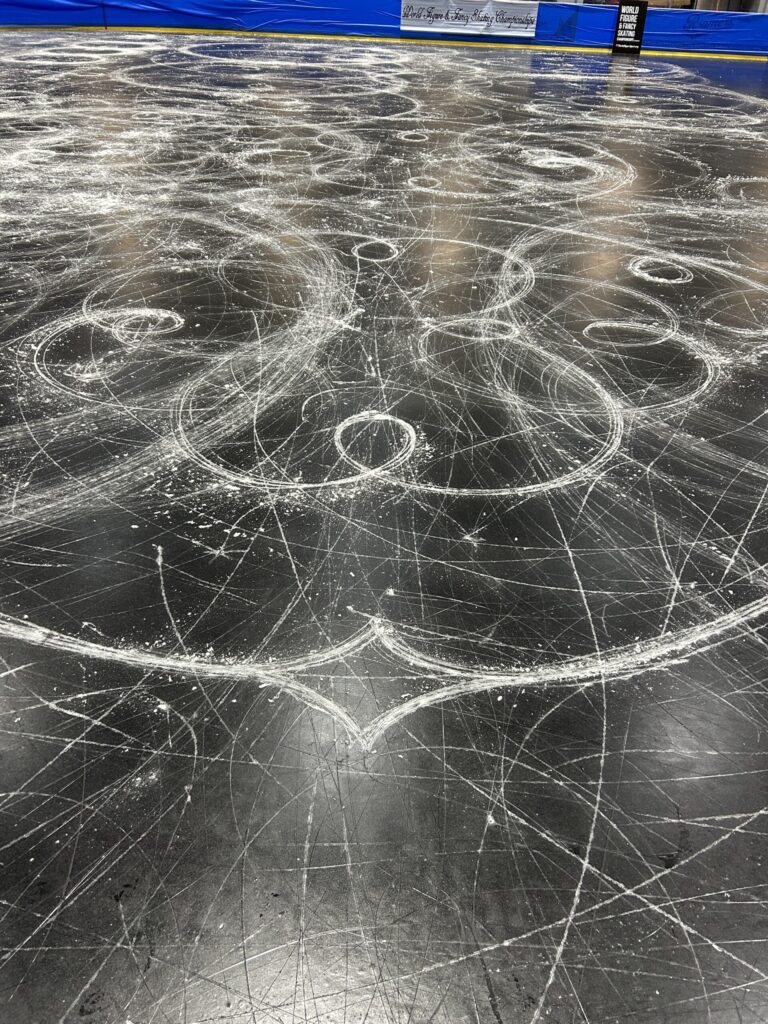
In fact, all three turns look alike — whether forward or backward, inside or outside. What shape is it? How is it created? What are the physics behind it? The three turn is made up of two curves coming together at a point at about a 45 degree angle (or a little more for the lower quality three turns in the upper right). Here’s a three turn in hockey skates, note the angle is a little smaller:
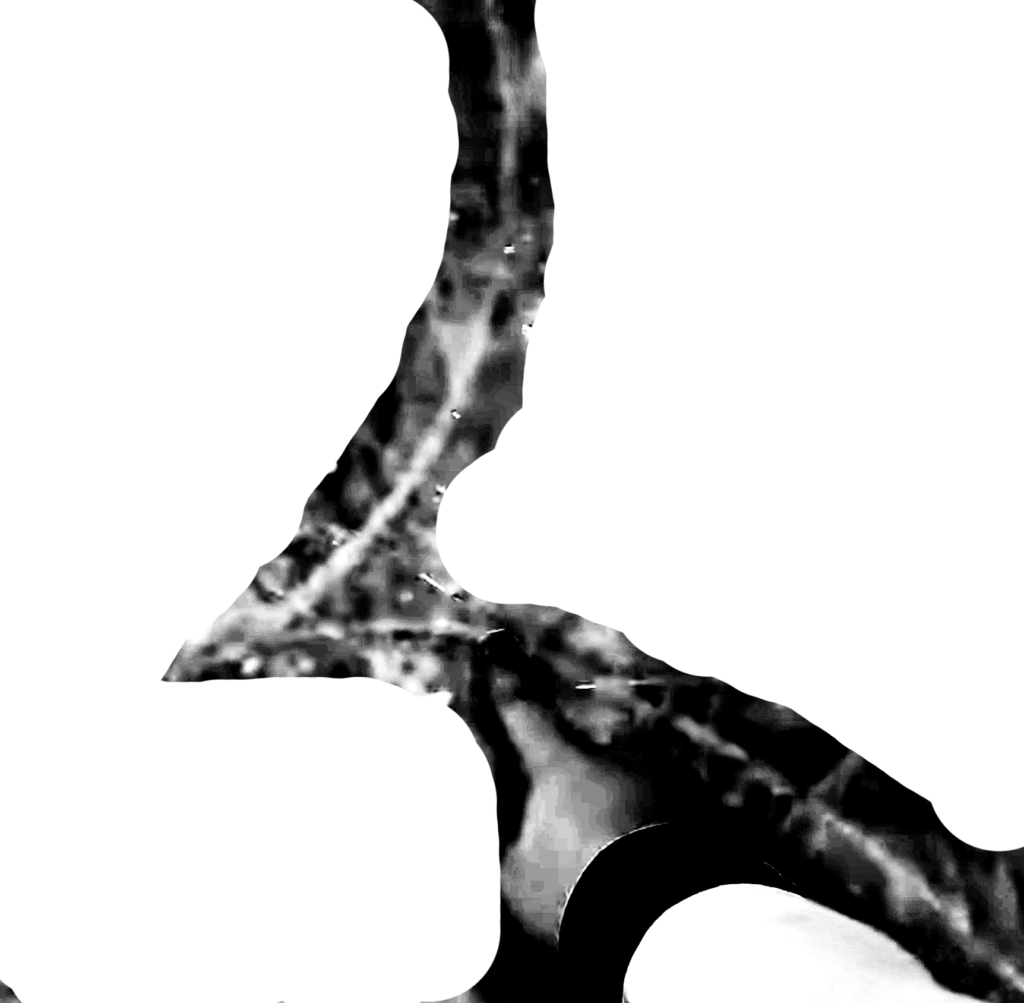
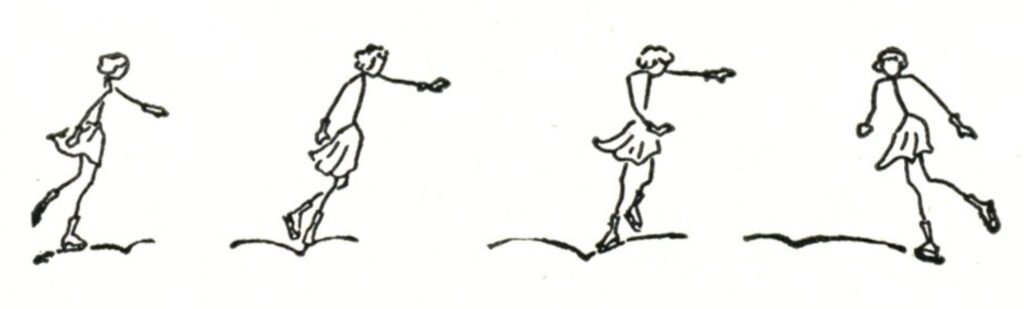
And here is a drawing of a 3-turn from Skating Magazine, April 1956, included in the margin to help readers understand and internalize the motion. Note how similar the shape is to the three-turn photos above.
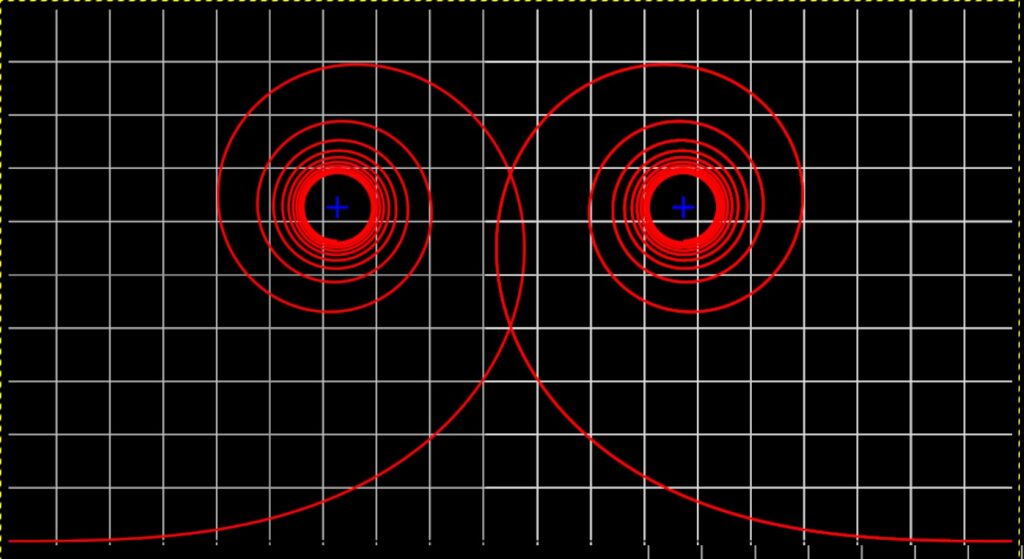
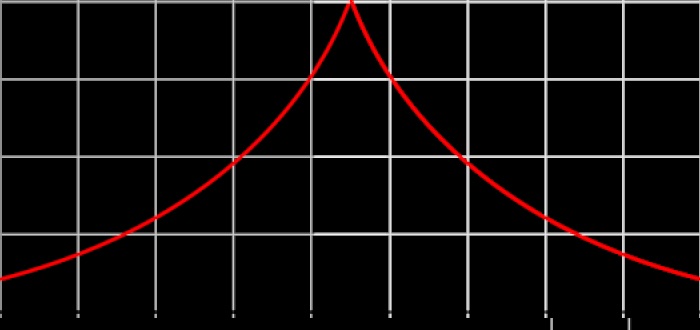
As with the loop, the curves going into the three turn will closely approximate arcs of the Euler Spiral. Why? Because the Euler Spiral is the shape you get when you vary the radius of curvature smoothly. It is not possible to vary radius of curvature instantly when skating, and the same physics apply whether looping or 3-turning. In fact, the three turn shape should closely match the beginning of the loop shape. On the left are two Euler spirals, and on the right is the three turn that results from them. Note the similarity to actual real-life three turns.
Three Turn Kinematics
The next question is, how does the blade make that shape? For a long time I thought about a three turn in terms of swivelling the leg under the body. Although there may be some truth to that, it does not explain the shapes we see; simply swivelling the leg would produce a scratch at the point of the swivel. Clean three turns do not have any scratching and happen in three parts:
- Entry Edge: The blade, which is already on a circular arc, enters the three turn by gradually reducing the radius of curvature. To first approximation the skater’s body remains close to the original circle while the blade diverges from it. As the blade curves more, it makes a sharper angle to the center, thereby reducing the centripetal force that holds the skater’s body on the circle, thus the skater’s body will travel in a flatter tangent arc across the top of the circle.
- Fold Over: As the blade turns into the circle, its component of forward motion tangent to the circle slows; and if the blade were to come fully perpendicular to the circle (which it does not but assume it does for now), for a moment the blade is not moving along the circle at all but the skater’s body still is (because it has a lot of inertia). Therefore, the skater will vault over the blade, shifting the blade from one edge to the other.
- Exit Edge: Having folded over, the skater needs to draw the blade back onto the circle and under their body (otherwise they will fall their blade after the first half of the three turn). As the blade turns back parallel to the circle, it regains the same speed as the skater.
Here’s a video illustrating that dynamic:
Of course that isn’t all there is to it:
- If the blade simply folded over, there would be a zero degree angle between the two sides of the three turn at the apex. But in fact there is a finite angle, about 45 degrees. So we know that the blade actually rotates as it is folding over. This makes sense: as the blade begins to turn into the circle, it acquires rotational momentum, which cannot simply stop when it reaches the apex. Thus, the folding-over begins to happen before the blade is perpendicular to the circle and is combined with a rotational motion .
- Gary Beacom noted that the change of lean is more gradual over the course of the turn than is shown in the smartphone video, not so sudden and confined to the top of the turn.
- The rotational motion does not create scrapes because the blade is curved at the bottom, therefore only one part of the blade touches the ice at a time — especially if the blade does not have too small a radius of hollow! Along with the rotation of the blade is also transfer of weight back-to-front (for forward three turns) or front-to-back (for backward three turns).
Starting with Twin 3’s
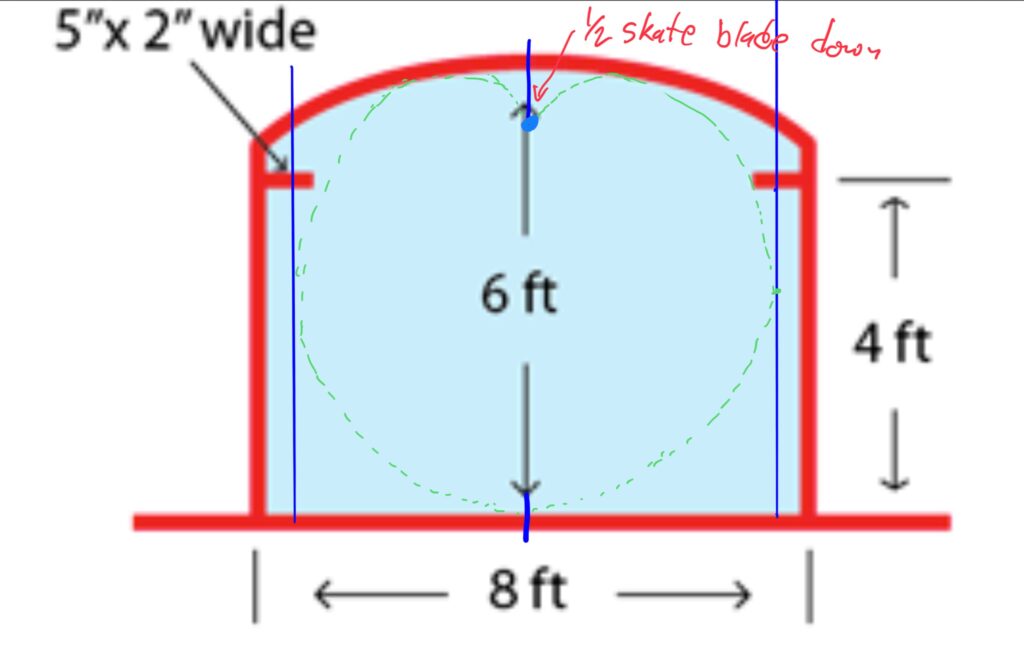
Twin 3’s are a fun way to build skills and practice 3-turns. The figure is practiced on loop size circles, i.e radius is about one giant step sideways, or 1 meter. In practical terms, the diameter of the loop size circle is about the height of the blue hockey box at the end of the rink. Here is a demo video, and also a picture showing how I like to lay it out.
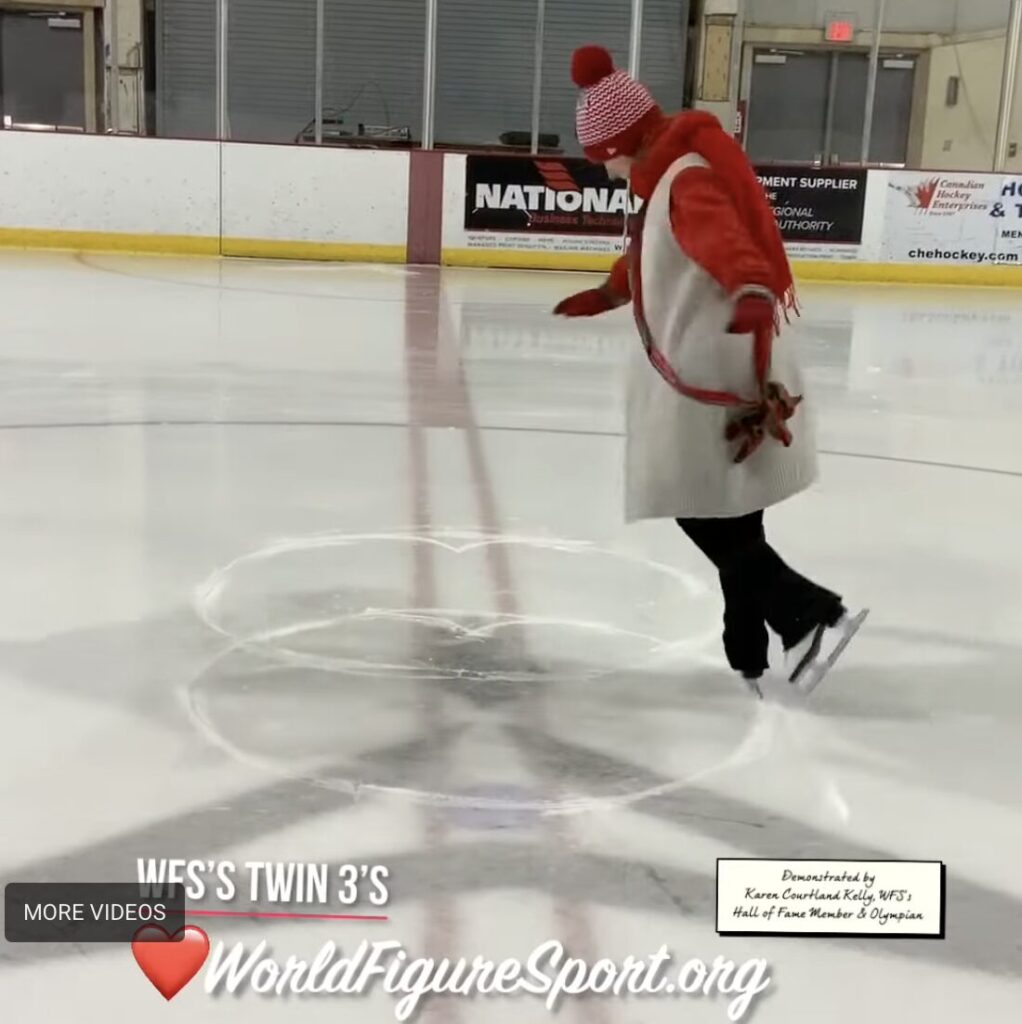
NOTES:
- Blue represents lines I draw with the heel of my skate. The two guidelines on the side create “boundaries” for the edge of the circle. Also a mark for where you start at the bottom, and where you place the apex of the 3-turn, about 1/2 of a skate blade down from the top.
- The green dotted line represents the path I skate on the 3-turn (I make better circles with my feet than my hands).
- The diagram above shows just the first of the two circles in the Twin 3. The bottom of the second circle starts in the center of the first, thereby creating two offset circles as shown in the video. I like to extend the guidelines on the side, hit them on the second 3-turn, and let the top fall where it may.
- I frequently witness people just starting to learn the 3-turn, trying it on the red round part of the hockey box. That circles is too big for good practice. The system shown above for twin threes, based on loop size circles, is easier and more beneficial.
- If you are having any problems, it can be helpful to first practice the figure on two feet: one is the “skating foot” and the other is the “guide foot.” Practice moving the skating foot into the circle and then pulling it back out as your body passes along the top on the other side of the three turn. Don’t worry over what the guide foot is doing. A similar kind of folding-over action is found on the grapevine.
- A clean three turn is silent. If you hear any scraping, you have not yet achieved a clean 3-turn. Keep practicing and figuring it out!
- As you become a Three Turn Ninja, you can start practicing Backwards Twin 3’s!
There is plenty more involved in three turns, especially on full-size figure circles. Those points will be left to the experts (see below). But as we learn as practice three turns, it is good to think about what happens with the blade, ice and physics below our knees, hips, core, shoulders, head, arms, etc. And we will do well to always keep in mind the beautiful shape of the three turn, made up two Euler Spiral segments!
Expert Advice on Three Turns
Gary Beacom has some excellent videos on three turns: