
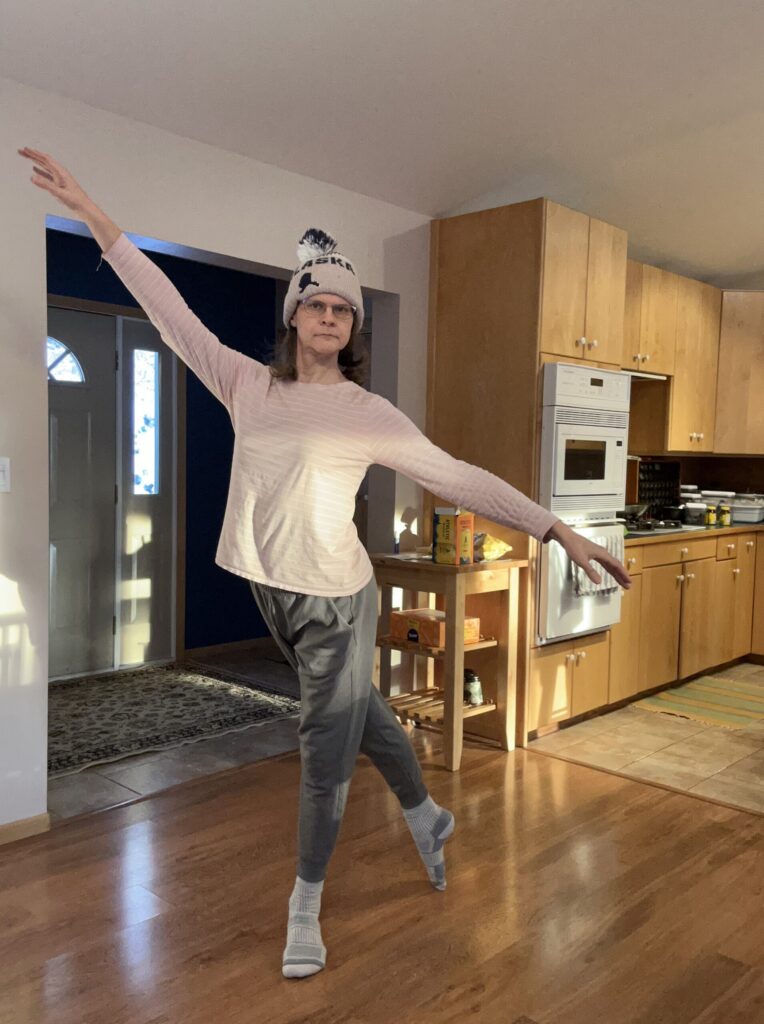
It is widely believed that technical achievement in dance is only possible for children, that there is an uncrossable chasm between adult students and fully trained dancers who began as children. Although this seems empirically obvious, I stand as a counterexample: I began professional ballet training at age 28 and two years later made it into a professional ballet company. More recently in 2024, I won the International Open competition in Figure & Fancy Skating after only 5 months of study. I won again in 2025, Fancy Skating to music I played on my violin.
These results did not come about by chance; but rather through careful training of my body using proven methods for adults. Dance training for children works through analogy, imagery and repetition. Complex human movements are presented in simplistic models, with the inherent complexity of the movement left to be re-discovered in the childrens’ bodies, usually subconsciously. This approach does not work with adults, who can easily study ballet for 3 years, 5 years, 10 years or more… and never build a useful or effective pile or tendu. Adults do better when the dancer’s thinking / analytical mind is recruited to take an active and primary role in training the neuromuscular system. I will now describe that approach in detail, one I have applied repeatedly while training in many disciplines including ballet, modern dance, Chinese Folk Dance, Figure & Fancy Skating and the violin, to name a few.
What are we Doing?
To many students the process of learning dance is mystifying; and in the absence of understanding, we cast around for answers. We tell ourselves that Suzie is doing well because she has the “right” body; or that success will be assured if we put ourselves in the “right” training program. Although these ideas might be true, they don’t get to the core of what we are actually doing in the dance studio, or what is going on in our minds and bodies while we do it, or why some teachers are more effective than others.
So what are we actually doing in a dance studio? Quite simple: we are building neuromuscular patterns of increasing complexity, like building a race car over time. We have all accomplished such training, for example learning to walk, type on a keyboard or drive a car. The difference in dance is that more movements and more complex movements using more body parts are trained to a higher level of precision. We bring our bodies into the studio, we learn “book knowledge” of how a position or movement works and then we train it into our bodies, step by step. We are bound by our biology, and the process requires dedication, patience, repetition — and time. We must enjoy the process. This process is new to most adult students, who have typically never seriously tried to train their bodies before, and therefore they must learn two things at once: the specifics of their chosen dance form, and the general process of how to train that in to their bodies.
In addition to training neuromuscular pathways, we must frequently condition our bodies to enable the desired positions and movements. Certain muscles must be stretched, others must be strengthened. This is the other main thin we do in a dance studio. In most cases, neuromuscular training and conditioning are intertwined and cannot be separated; and in fact, the ballet exercises do both at once. This distinguishes dance from many sports-oriented forms of athletic training, in which conditioning is done separately from practicing the movement.
That is, in a nutshell, what happens in any dance studio of any genre: we train neuromuscular patterns, and we condition our bodies to execute them. Conditioning increases our bodies’ basic capabilities (to a point), and training makes use of those capabilities to create desired dance positions and movements. There may be limits to neuromuscular plasticity and conditioning as we age; and dance training over years may eventually reach one or both of those limits. But in my experience, most adult students are nowhere near those limits.
Working With a Body
We are training our neuromuscular system, a portion of our brain that similar to that of many other mammals. As with training a horse or a dog, a human intelligence is putting a neuromuscular system through its paces, and things become automatic with time; we have a “thinking body” that can take direction from our “thinking mind,” and in fact optimize the movements we teach it over time. The process of teaching our body new tricks works like this:
- First we have to know exactly what we want our body to do. As a student, we need a teacher to explain this to us.
- We do our best to put our body through the motions. Because our thinking brain is running the show at this point, the motions will be slow, approximate and inefficient.
- We evaluate the result. As a student, we need to learn the criteria for evaluation, which will be different for each different kind of dance. And we must get feedback with our eyes, ears, mirror, video, inspection of tracings on the ice, etc. In many situations, we get the results while we dance, and make adjustments in real time.
- Based on the evaluation, we figure out what we need to fix and try again. Rinse, repeat. If we know it’s not working out right but don’t know how to fix it, we need to stop go back to our teacher. If it starts to get worse, definitely stop for the day! If a movement starts out wrong, stop it at the point where it went wrong and start again, don’t just correct and go on. That does not train the movement we actually need.
- With repetition, the movement we are teaching our body becomes automatic. That is why it is important, as much as possible, to only repeat correct movements.
- We go home and rest. After we’ve practiced, our body is able to integrate the experience while we sleep and come back better the next day.
- Teaching 100% correct movement is just not possible at the beginning: the movements are too complex, and the models we learn from are too approximate. As we gain experience we listen to our body and come to understand things more deeply. Then we go back to movements we learned earlier and learn how to do them better. Dancers are trained through constant review and refinement of the basics, with focus on quality of movement.
As we train we build first awareness, and then control, of body parts we were not previously aware existed. We call this awareness through movement. Which body parts gain awareness depends on what we are training, and in fact results in changes in the amount of our brains dedicated to controlling said body parts. For example pianists have large sections of their brain dedicated to their hands. As we build awareness of the body parts important for our kind of dance, we can begin to work body parts in coordinated ways. One time, coordination optimizes into integration: in which the viewer sees not a bunch of body parts moving together, but rather one body moving in a seamless and sophisticated manner. A single impulse, a single movement.
Training a Technique
In dance, especially technical forms of dance such as ballet or Figure & Fancy Skating, the dancer is attempting difficult physical feats: for example, balancing en pointe with one leg in the air while turning multiple times on the other; or carving a precise pattern on the ice while balancing on one leg on top of a blade; or jumping into the air — and landing without injury. Technique is how we execute our moves safely and efficiently. Technique is trained into our neuromuscular system at the deepest level, and our body conditions to it. Correct technique will take us far. Bad technique will prevent us from progressing or leave us injured.
We also talk about “artistry” — the act of doing something in an artistic manner, meaning doing it with an eye toward aesthetics. Artistry is not to be confused with art. Anything can be done with artistry, for example kicking a field goal or dribbling a basketball. But applying artistry does not make something art. Art is art if its main goals are aesthetic.
Technique and artistry are often contrasted with each other, as if they are separate endeavours. And we see it on stage: some dancers with clinical technical polish, contrasted with others who dance with flawed but authentic soul. But the two are not separate, they are intrinsically linked. If we struggle with the technique, then that’s what we will be thinking about and artistry goes out the window. If we struggle to stay on balance, then our body will protect itself, tense up and expend extra energy, and the movement will look bad. Thus, technique is not separate from artistry, rather it is the foundation that enables us to perform as we imagined when we first became enthralled with dance. Technique makes everything easier and builds confidence. And once we have built technique into our body, nobody can ever take it away from us.
For this reason, the main goal of any student should be to learn technique as efficiently and effectively as possible. Professional ballet dancers are trained on 5x 1.5 hour classes each week in which techinque is the primary goal. Working with choreography, putting on a show, or entering a competition may also be an essential part of one’s training, but they should not get in the way of technique. Too many students get distracted by these activities too early in the training process. And if the student has limited time, they should consider allocating it all to techinque. Successful dancers love the techique, and they love trianing it in detail. For figure skaters, figures are well established as the best way to train technique, and students should spend most of their time on them, at least for the first few years. Sure, attend a competition if you like, nothing wrong with that, but it will not do much to make you a better skater. Instead, consider gaining performance experience where it is cheap and easy, for example your local club’s seasonal shows. Keep it simple, build your choreography out of the things you’re working on, and don’t let it interfere with your technique project.
Technique is not just a series of “how to” tips, but rather a set of positions, movements and principles that fit together like mathematics and build on each other. For example, consider a forward outside 3-turn in skating. It may seem simple enough but it can be broken down into a forward outside entry edge, a backward inside exit edge, and of course the turn in the middle. The entry and exit edge each require a specific body position, and the turn requires a specific sequence of movements of body parts: knees must bend and straighten, the spine must twist slowly, then untwist and re-twist in an instant, weight must be transferred, core posture must be maintained. A beautiful, functional 3-turn requires each of these parts to be working well; and in fact, there are exercises for each one of them. What we learn on basic edges is re-used in 3-turns because 3-turns contain basic edges! And so on. Technique also involves general principles. For example, ballet is always turned out. Imagine we are considering two ways to do something, one that will increase our body’s turnout and one that will collapse it. Understanding the general principle, we should be able to reason which one is right (within the ballet technique), without having to ask the teacher.
Technique is therefore something we can think about and reason about. Good teaching will elucidate these principles for the student, engaging the intellect and the body simultaneously. Whereas poor teaching fails to identify the connections and principles within the technique. Good teaching will always teach basic positions and movements before teaching more complex steps that depend on them, sequencing is key. Whereas poor teaching asks students to do more complex things without ever breaking it down or preparing them properly. For example, the USFS Skating Skills curriculum asks students to do a forward outside 3-turn before providing any instruction on a backwards inside edge. That is a problem. In contrast, the master teacher Mirabel Vincent would not allow her students to begin learning jumps until they mastered the 2nd Figures Test, advice we would be wise to follow today.
Parting Thoughts: Technique is (almost) everything. Treasure it like gold, do whatever you must to get it, change teachers if you have to, practice it obsessively, love it to the ends of the earth. And you will go far with confidence. (Almost) nothing else matters.
Setting a Schedule
Neuromuscular training requires frequent repetition. How frequent?
Ballet dancers are trained on 1.5 hours a day, 5-6 days a week, for 8 years. Although dancers spend additional time in rehearsals, it is not as intense as the basic daily 1.5 hour techinque class, and more than one class per day could cause injury. Out of that 1.5 hour class, 45 minutes is spent a the barre, 30 minutes on center exercises and turns, and no more than 15 minutes at the end spent on jumps. This training schedule has been used by professional ballet schools for over a hundred years, and over that time has been well documented, optimized and systematized by many brilliant teachers. Ballet students might practice on their own at times, but most of the training takes place in a group class under the constant eye of the teacher. At least one day of rest is essnetial to avoid injury.
In contrast, professional musician training is focused around a 60 minute lesson once a week, with the student practicing 2-4 at home 2-4 hours a day. More technique practice is possible for musicians than dancers because it is less stressful on the body.
Daily practice is essential for pre-professional musicians and dancer. For students practicing less frequently, they should be aware of what to expect, and how our neuromuscular system is likely to respond. Once-weekly practice is simply not enough to train neuromuscular patterns, as our body “forgets” inbetween sessions. Three times a week is typically the minimum required to avoid this problem, make steady progress and not get frustrated or bored. Therefore, practicing 3-6 days each week should be the goal for any dance student; and if only 3 days are available, practice should be focused almost entirely on technique building. More time practicing leaves more time for the “extras.”
As with musicians, training for figure skaters tends to be centered around private lessons. Many competition skaters are coached 30-50% of their time on the ice. However, winning competitions is different from building technique, and coaching is different from teaching: teaching addresses overall skill development, whereas coaching seeks to achieve the best possible outcome for an upcoming performance. Teaching and learning are easier without the pressure of performance. That is a time when we can take apart the technique, try different things, see how it works, and then reassemble a better technique. The musician model serves well for the student focused on building technique: one weekly lesson, coupled with daily practice of what was learned in the lesson. If the student
Following the ballet model, skating students would do well to spend much of their on-ice time practicing figures, spins and other skills in the field, while confining jumps to the end. Not only is the body fully warmed up by then, but it has also practiced all the technique involved a complex movement like a jump, maximizing chances of success. If something is going wrong in a jump, it is hard to fix while jumping, that could require many trial jumps and lead to injury. A smarter approach is to figure out what’s going wrong, work on the parts individually, and then re-assemble the jump and try again the next day. A jump is a finished product, not a place to fix technique basics.
Working with a Teacher
Every student learns differently and every teacher teaches differently. The best teacher for you is the one you will help you build technique most effectively. Do not continue working with a teacher where that is not happening, even if you like them personally. Teachers are professionals, they can manage. But diving deeper, what can we expect from our teachers? Consider again the process described above, there are three key points the teacher’s input, as an expert in the field you are trying to learn, is critical, no matter how experienced you are in working with your body.
- Nobody can guess how the technique works, you need a teacher to explain it for you. When you are learning a new position or move, they should be able to tell you exactly what you need to do, in detail, with each body part. If they expect you to “just do it” without explaining, they are not adding value and you need a different teacher.
- The teacher can evaluate your results. More importantly, they should be teaching YOU how to evaluate your results. They will help you not only distinguish good dancing from bad dancing; but also learn to prioritize which things matter, and therefore where to focus your attention. The better you can evaluate your results on your own, the more effective your practice time will be.
- The teacher can show you your mistakes and how to fix them.
- The teacher can show you alternative easier / more effective ways you didn’t think of.
- The teacher should understand and communicate what you, personally, need to work on next to build the technical, priorities. Because they understand the full picture, whereas you only know what you’ve learned so far. This is the difference between a good teacher and a great teacher.
Therefore, coming out of your weekly lesson, you should know: (a) exactly what you are working on and trying to accomplish this week; (b) how to evaluate your results; (c) how to fix things if they are not working. You should keep notes and write all this down, then practice it over and over again until the next lesson. If you come out of a lesson not knowing what to do on your own or how to manage your practice time, that is a problem. If you find things you don’t know how to fix during the week, bring them to your teacher at the next lesson. If this is not happening for you, find a different teacher.
In tandem with learning the specifics of the technique, most students also need to learn the process described here. Hopefully this article will help with a head start, but learning it experientially and using it effectively still requires working with a good teacher and a lot of practice.
Final Thoughts
So, that’s the core of the process… now it’s time to go out there, set up a schedule, find appropriate guidance, learn the specifics of what you are trying to accomplish… and practice, practice, practice! But think while you are practicing, always keep thinking and observing your body and trying new things. Improvement is about change, and you must be willing to change how you dance every day. And don’t be afraid to not know things: I was taught that what makes a professional dancer is we know what we don’t know. Have fun, stay safe, and enjoy the process!