
Beginning in 1992 figures were “abolished” from the sport of figure skating by the ISU. Since that time, there have been endless debates on whether that was a good idea, or whether they should be “brought back” to the sport. Because the sport of figure skating is a sport, and sports have rules set by global governing bodies (cartels), and participation in the sport outside of the governing body is not possible. Thus, the endless petitioning by membership with little power for rule changes in a social system that enforces compliance and uniformity over creativity and individuality.
My prediction: figures will never again be part of the sport of figure skating, because the conditions that drove the decision have not changed. Modern sports run on money, and in the USA figure skating broadcast rights tripled in value when figures were removed from competition. No one ever claimed that Moves in the Field would be a better way to train, just cheaper. It did not reduce the cost of elite training because of the arms race inherent in elite sports. But it did reduce required ice time (and therefore cost) for the 99% of non-elite skaters, which led to increased participation, as defined by competition registrations. Rinks adjusted to reduced demand, making high-level training less accessible than ever: the days of public school children figure skating an hour before school are over. Regardless of quality, abolishing figures set governing bodies on a path of increased funding from sponsorships and broadcast rights, and increased spending on elite athletes. From a boardroom perspective, the change has been a resounding success. No amount of petitioning from skaters who remember the days of paragraph loop competitions will change that. We must think more creatively.
As a ballet dancer, I always believed that what I did was different from sports: beautiful music, beautiful spaces and most importantly, an ethos of continued refinement in the way we used our bodies. The point was never just to score a goal or land a jump, but rather to train our bodies to the highest of precision and refinement, a “goal” that can never be reached. Thus we spend half our training time holding on to a barre, working on the most minute details. Ballet is multi-dimensional, making it impossible to compare dancers on a linear scale. When we watch other dancers, we don’t count how many times they spin. We do assess refinement in how they roll through their feet coming down off of pointe, or how they use their arms, hands, shoulders and head in an integrated manner. That stuff counts for everything! This attention to aesthetic detail underlies ballet’s well established reputation as a performing art and not a sport. Technique enables expression.
The art of ballet and the sport of figure skating historically shared common traits. Both were concerned with aesthetics. Both trained the human body to astonishing levels of precision. Both existed as multi-dimensional practices. And both required highly capitalized institutional frameworks. But there were always differences, and those differences have increased with IJS and the abolishment of figures. Figure skating today is more physical, less refined, less precise, more one-dimensional — more like other sports, prioritizing the purely physical over neuro-muscular sophistication. The level of precision achieved by the likes of Trixi Schuba was downright astonishing; however, the culture of figure skating only admired it to the extent it won competitions. It is therefore no surprise that figures were abandoned at the point that they no longer served the goals of the sport as defined by its governing body, which members have no role in choosing. This is frequently described as “the evolution of the sport,” in a way similar to the evolution from horseless carriages to modern automobiles.
The way forward for figure skating — and figures — lies in understanding that it is not inherently a sport. The practice is over 200 years old, and in that time has served multiple social roles: art, sport, social dance. Its status today as exclusively a sport is a result of its history, not a fundemental aspect of the practice. It could again function as art, or social dance, or some other role in society. The concept of “art” is frequently used to collect practices considered obsolete by the modern world. Photography supplants portrait painting, which becomes high art. Traditional music and dance are preserved by placing them on stage. By maintaining art traditions, we maintain our sense of who we are, where we came from and where we are going. Art is a carrier of culture — something Janet Lynn also said about figure skating.
I am most interested in figure skating’s ability to function as an art and carrier of culture; and in that capacity, to shape our mind and body and spirit and to make us better, more open, more compassionate people. When I step on the ice, my goal is to train my body to the highest possible level of refinement, precision and control. So of course I practice figures! Because I am convinced that just around the corner, I can lay down the most beautiful figure artwork composition with an amazing feeling of balance and control as my body glides over it as if on railroad tracks, carving image out of blank ice. And when I am done with that, my body can become the art, moving sculpture as I fly and dance around the rink! Who is it for? An audience is nice, students are better, but my art has purpose whether or not otherse see it. Other skaters can and do envision their pratice differently. That is OK: art requires indivuality and bodily autonomy. Thankfully, what I do is far more financally accessible than participation in the sport, which seems designed to be as expensive as possible.
So where do we go from here? I don’t know what “the future of figures” looks like. World Figure Sport exists today, but I don’t know how social communities will organize around figures in the future, or how they will conceptualize themselves along an arts-sports continuum. But dance is a living art form and I do believe this movement language and cultural legacy has inherent value and needs to continue. And that will only happen when people put in the effort to learn it and practice it in their own search for the ultimate 3-turn; and then pass it on to the next generation. I am lucky to be part of that legacy.
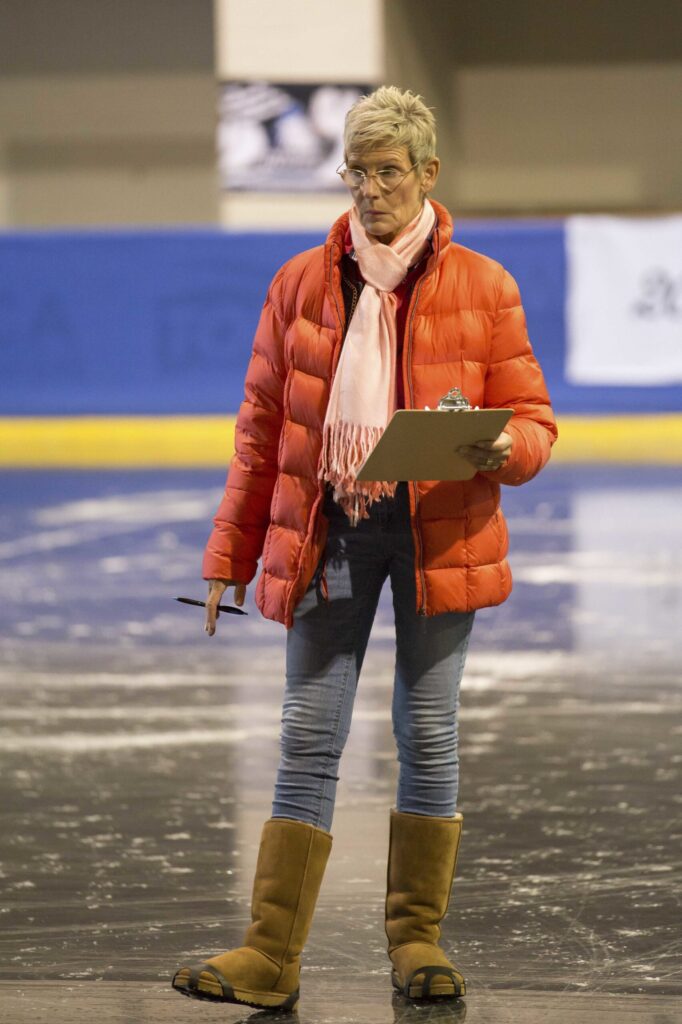
Photo: Trixi Schuba serving as a judge at the World Figure Sport Figure & Fancy Skating Championships on Black Ice, 2018