
When we deliver a top-notch dance / skating performance, the audience will be captivated the whole time. They will use words like “presence,” “authentic” and “captivating” to describe our what they saw: the magic happened! We grabbed their attention and held it! But when we fail to engage the audience… they’ll be looking at their phones within 30 seconds and they won’t have much to say at all. Unfortunately, most figure skating performances I see, regardless of how many IJS points they get, fall into the second category. One skater might throw a beautiful double Salchow jump, but it is preceded and followed by a bunch of “meh.” Another might suddenly swing limp arms in a circle on a Mohawk turn; but without connection through the back, it’s just a body part flying around for no reason. And finally, another skater might throw a waltz jump that lands without falling, but looks like an unintelligible tangle of legs in the air.
These are all problems related to form and movement quality: the shapes our body makes, and the ways we move it between shapes. Form and movement quality are highly topics that are core to what ballet is all about, far more important than the tricks; and as dance or skating artists we spend years mastering them. There is no separation between “artistry” and “technique,” they are not things to “add on” to our work once we’ve “gotten the technique,” nor are they only accessible at an advanced level: anyone at any level can and should pay attention to form and movement quality, and we all gain technical benefit from the effort. Even if the only skill we have mastered is forward outside edges, we can improve our performance by thinking about your form and movement quality as we skate those edges.
In language, we communicate using structured sound. If we mumble our words or are speaking over a noisy channel, our listener might not hear what we said. Language has enough redundancy that they will subconsciously “fill in the blanks.” But filling in the blanks is work for the listener, and things work best if we speak clearly in an environment free of noise.
Similarly within a movement language — ballet, figure skating, etc — we communicate by performing “words” from the movement language in a way that people watching can understand. For example, figure skating happens on one foot, gliding on an edge in a circular arc. Most of our audience will have seen figure skating before, and will subconsciously classify every edge we skate. If the edge is not clear to them — for example we step on a flat, or we waver — they will “fill in the blanks” and try to divine what we meant to skate. But that is jarring and requires extra effort from the audience. In a similar vein, if we are riding an edge and our body parts are moving around in random / unnecessary ways, it will be confusing: “should I look at her head, or her right arm or her left leg?” There is never a solid “picture” for the audience to see and absorb, nothing memorable. The principle is the same in both cases: clean technique is clear communication: not just more functional, but also more engaging to watch! That is why a ballet dancer, if they are skating, will always choose a beautiful, clean double jump over a messy / under-rotated quad, thereby illustrating one difference between art and sport.
Clean Technique: Holding Still
To get this clean technique, we start by eliminating non-essential movement, either at the barre (in ballet) or on our figure eight (in skating). Consider, for example, the humble forward outside eight (FO8) figure. A beginner will push off, then struggle to balance as they are flying around the circle; and if they are lucky, get back to the center. When did the free leg move, or the arms, or the shoulders? No one knows, everything was moving all over the place all at once! In contrast, an advanced skater will hold a lot more than they move. First they will make one movement (and just one movement) to push off and put their weight in exactly the right place on the blade. Now that their body is where it needs to be, they will simply hold still until they need to move a body part, for example bringing the free foot forward at the top. And so it goes: the movement is as minimal as possible, and the holds are as long as possible, and the final result is engaging to watch. People see it and they are inspired to practice figures because what they see seems so calm and meditative — and for the skater who has achieved that level, it is in fact calm and meditative! Here we see an excellent example of holding still on FO8. Notice how the performer makes only two movements: one at the center and one at the top. At all other times, she is holding perfectly still!
Karen Courtland Kelly demonstrates the Forward Outside Eight (FO8) figure. Notice how still she holds her body. Copyright (c) World Figure Sport, Used by Permission.
Form, Movement Quality and Principles of Aesthetics
Form refers to a shape we make with our body: Are we on an edge or a flat? Forward or backwards? Outstretched or compact? Tall or short? Twisted or square? We should all play around with these concepts on the floor in front of a mirror, trying different positions and seeing which ones we like better, and how our body feels in each one. Figure skating shares its aesthetic DNA with ballet, even though its technique is different in many ways: the International Style of skating dominant today was founded by ballet dancer Jackson Haines in 1860’s Vienna! But in a world where all human movement is valid, why do we prefer some shapes over others? Many factors go into this, understanding that every aesthetic principle has its rule breakers:
- Balance: /Verticality We prefer balanced form over off-balance form because it is uncomfortable to watch people fall. Verticality follows from balance: if we stack up our body parts on top of each other, they will naturally balance with little effort. In figure skating, the “vertical” will be on a lean, but it is still in line with the effective gravity vector. In contrast, modern dance explores off-balance shapes that begin to fall but do not fall all the way, or that fall but do so in a controlled intentional way.
- Principle of Least Action: Positions that avoid unnecessary effort to hold are preferred. In ballet, once we learn to stack up all our body parts over our standing leg, we find we can move our other limbs around with ease. A correct position requires less effort in the end, and thus our body is more relaxed, ready to move as needed, not “gripping.” The principle in figure skating is similar, as we struggle to maintain relaxed balance over a blade. Our bodies are smart! As we practice a body position or movement over time, our body will naturally relax and find the most efficient way to hold the position and execute the movement.
- Form Follows Function: We prefer forms that enable execution of our movement language. For example, in ballet turnout is functional (to improve balance and freedom of motion of the limbs), and hence it also became an aesthetic goal of its own. In figure skating, turn-in is required to push off backwards. The turned-in strike position before a backwards push would be terrible form in ballet, but it is considered good and beautiful form for figure skating. Similarly, sickled feet are frowned upon in ballet because landing on a sickled foot can sprain an ankle; whereas divers sickle their feet together as part of good diving form.
- Classicism: Classicism is an aesthetic based on the principles of ancient Greek and Roman art, emphasizing order, balance, symmetry, and idealized form. Ballet is a classical art form in the sense that it adheres to these aesthetic principles. Skating aesthetic has been informed by ballet’s classicism as well. Modern dance is not classical, at times intentionally anti-classical, or alternating between classical and non-classical forms. As long as we are working within International Style free skating based on ballet aesthetic, we will do well to consider aspects of classicism in our performance.
Whatever positions we choose for our body, it is important that these positions are “alive” and maintain “presence.” Everything we do must be with our whole body, analogous to an actor remaining “in character” vs “out of character.” The principle of presence is well demonstrated here:

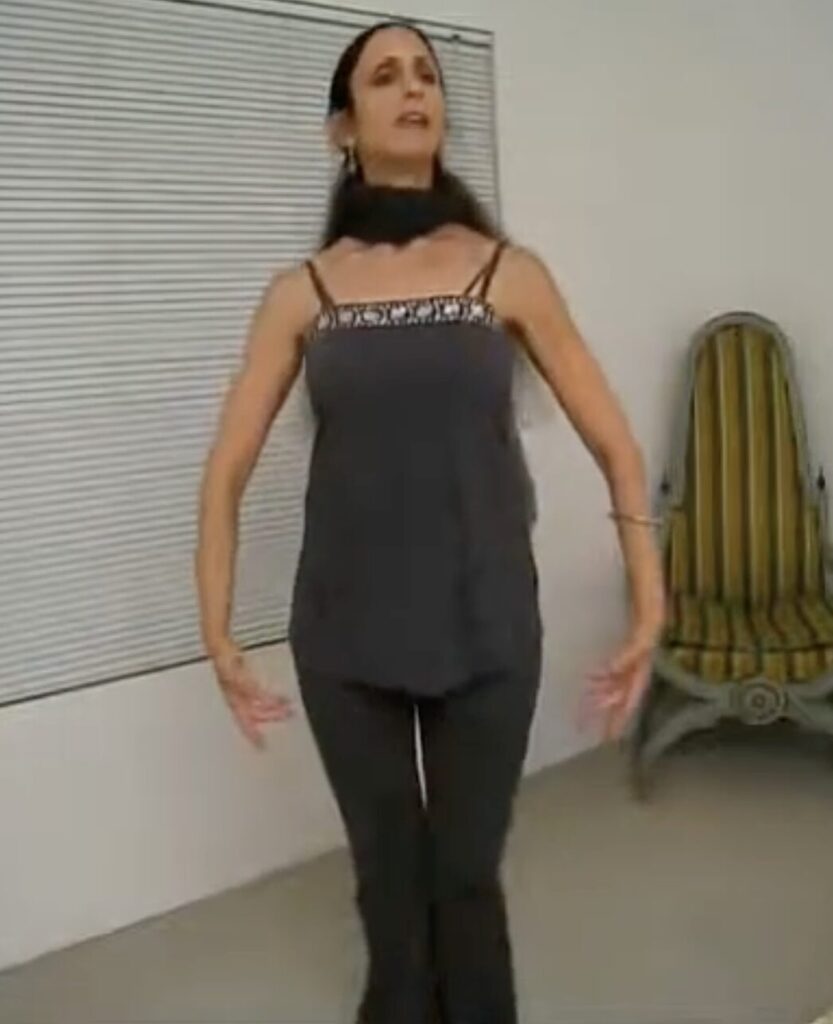
Ellen Davis is just standing still.
Ellen Davis is alive, filling the room with her presence.
Line: The Holy Grail
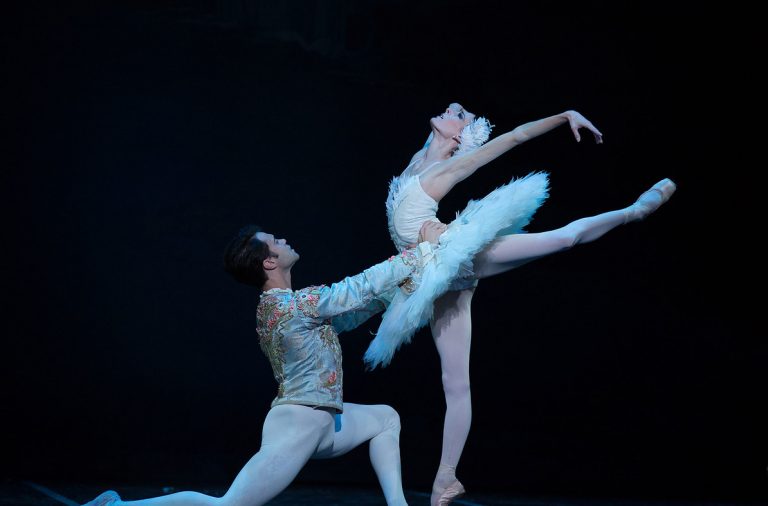
Line is one of the most important principles in ballet. It refers to shape a dancer creates with their body, encompassing the alignment of limbs, torso, and head. It highlights the extension, posture, and artistic flow—often compared to cursive writing—that makes movements look graceful, coherent, and visually appealing to the audience. Great effort is taken in ballet to not “break the line” — for example, avoiding sharp bends at the hips, elbows or knees, and also avoiding costumes that would visually break the line. Here are just a few examples of beautiful line. On important stage principle is to hold all four limbs and head so they are clearly visible and not foreshortened (i.e. pointing toward or away form the viewer). Things work differently on the ice, where the skater is constantly rotating: skating is viewed by the audience in a more three-dimensional manner than ballet.

Carol Simkins of Ballet science demonstrates beautiful line: One long line from fingertip to fingertip, her legs extended in a second almost-parallel line, and her costume adding to the overall effect with its own line! All four limbs and head are clearly visible. Used by Permission.
Swan Lake attitude. Note the continuous curved line from the tips of the fingers, through the back, and out through the tips of the toe; and also the continuation of the line between the two dancers’ bodies. Photo by Rosalie O’Connor Courtesy of Boston Ballet.
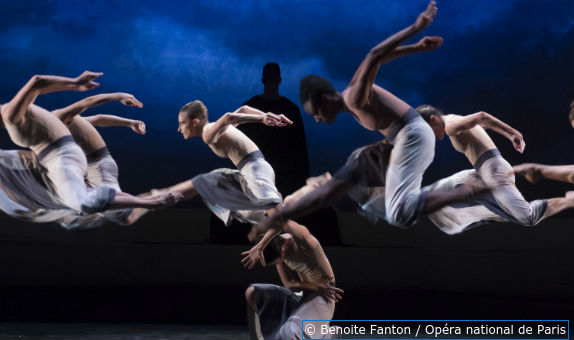
The Martha Graham Company using intentionally broken lines to create a beautiful non-ballet aesthetic in The Rite of Spring. Copyright (c) Benoit Fanton.
Quality line is developed starting with the tendu (stretch) ballet exercise, where we learn to fully lengthen / straighten our leg while turned out, front side and back, finishing off in a fully pointed foot. As beginners we think our leg is straight but it is not in fact straight. With time and practice, we learn to make a beautiful line in tendu on the floor, and to gradually lift that line up to our waist height and above. For figure skaters these concepts can be developed on-ice by studying figure artwork, John Curry style center exercises and traditional ice dances, and paying close attention to line throughout.
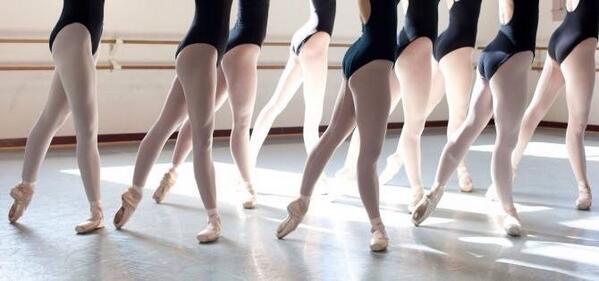
Students developing line through tendu back exercises. From Danza Rebeca Garcia
Some of the most beautiful lines occur in arabesque positions, such as the Swan Lake attitude above, which also form the basis for figure skating spirals — so called because if you glide in the position long enough, you will draw a spiral on the ice as you slow. down. John Curry brought these concepts of ballet line into his free skating, to beautiful effect. Line is also import in ice dance, where a quality push will be finished off with a beautiful line in tendu back or front.

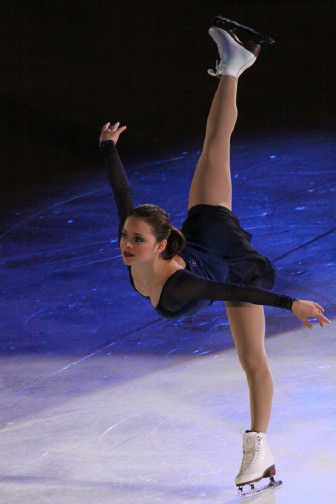

John Curry brought a strong ballet aesthetic and sense of line into his skating. Photo Courtesy MacLean’s Magazine, 1979
Sasha Cohen in an arabesque spiral position, similar to penché arabesque in ballet. By David W. Carmichael – , CC BY-SA 3.0
Joel Dear and Christian Erwin display excellent extension and line with their legs and arms. From the Icebreakers film, by Marlo Poras Productions.
Movement Quality
.Whereas form refers to the shapes we make with our body, movement quality refers to the way we change our body’s shape, transitioning from one position to another. It’s a complicated topic that we spend years studying and perfecting; I will only briefly introduce some of its principles here. But make no mistake, in ballet movement quality is more important than anything else. We love our tricks, but in the end movement quality is the difference between great ballet and “meh” ballet.
- Speed: Are we moving our body parts fast or slow?
- Articulation: Are we moving our body parts in quick jabbing movements, or smooth continuous movements, or more like dragging our limbs through molasses?
- Path: What path through 3D space do our body parts take?
- Simplicity: Are we taking a direct, simple path from point A to point B? Or a roundabout path?
- Linear vs. Circular: Are we moving our body parts in straight lines, or in circular arcs, or something else?
- Cleanliness: Are there any extra unnecessary movements? For example, a small wobble after a step as we catch our balance?
- Stillness: We we are supposed to be still does our body remain 100% still in all parts, without little wiggles or catches?
- Full Body Integration: High quality movement arises from a single impulse deep in our body that causes all body parts to move, and stop moving, in an integrated manner. Like a flower opening or closing. Ballet port de bras (“wearing of the arms”) is an excellent example of this principle. At first glance port de bras is a specified set of arm movements through space. But in a well done port de bras, arms are held up through the back and they never move alone; rather, arm movements are accompanied by subtle movements in the head, neck, chest, back and torso. Quality port de bras gives life and breath to our dancing! See here for some excellent integrated movement with beautiful port de bras (from Ballet’s Secret Code – A Documentary). Contrast to this video, where movements is far less sophisticated, less refined, and the arms move with little or no connection to the rest of the body (no integration).
Creating Snapshots
Movement quality can be used not just to create interesting movement, but also to create the “snapshot” pictures for our audience. When we dance, our body goes through many positions: some have great line and beauty that we want the audience to see, whereas others are… well, we have to go through them to get from point A to point B. We emphasize the “good” positions by holding them as long as we can, while moving through the “transitional” positions as quickly as possible, thereby creating “snapshots” for the audience. This approach creates a clean look, where our dynamic and articulation guides the audience on what they should be looking at and what we want them to remember. It is the equivalent of speaking with clear articulation. By holding some positions and moving faster between others, we also create space between the movements, allowing us to execute them in an unhurried fashion, even if they are quick! The opposite is to just go through the motion in an undifferentiated manner, with no positions really held any longer than others, just going through all the positions, frequently looking rushed or late or both. That is like mumbling. Here is an excellent video touching on the use of movement quality to create snapshots:
Christina Krigolson of Face the Barre explains the idea of creating “snapshots” in the air, in the context of the ballet glissade.
The Ultimate Waltz Jump
Now we have the principles needed to create and understand the ultimate waltz jump. Here we see line drawings of the different positions our body goes through on the jump, from takeoff to positions in the air to landing:
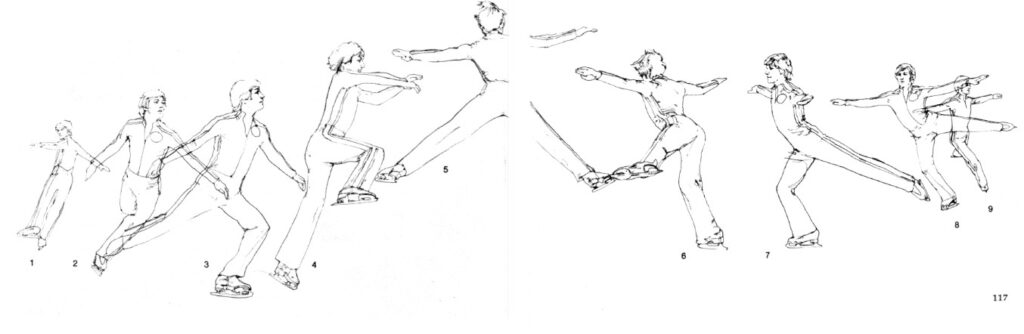
From Skating with Carlo Fassi, Copyright (c) 1980
All of these positions are functional and necessary for a (high quality) waltz jump. But which positions do we want the audience to see and remember? Positions 1 and 2 are OK as is the landing in 8/9, but Positions 4 and 6 are actually awkward. Position 5 is the high point of the jump, not just in elevation but also extension and line. This would be the one we want to emphasize: to make sure we fully extend our legs and point our feet (as in tendu), and try to hold it there in the air as long as possible. The higher we jump and the faster we move through the positions going up into the jump, the longer we can hold the climax for our audience! We do all this, of course, through careful attention to form and quality of movement, as shown above.
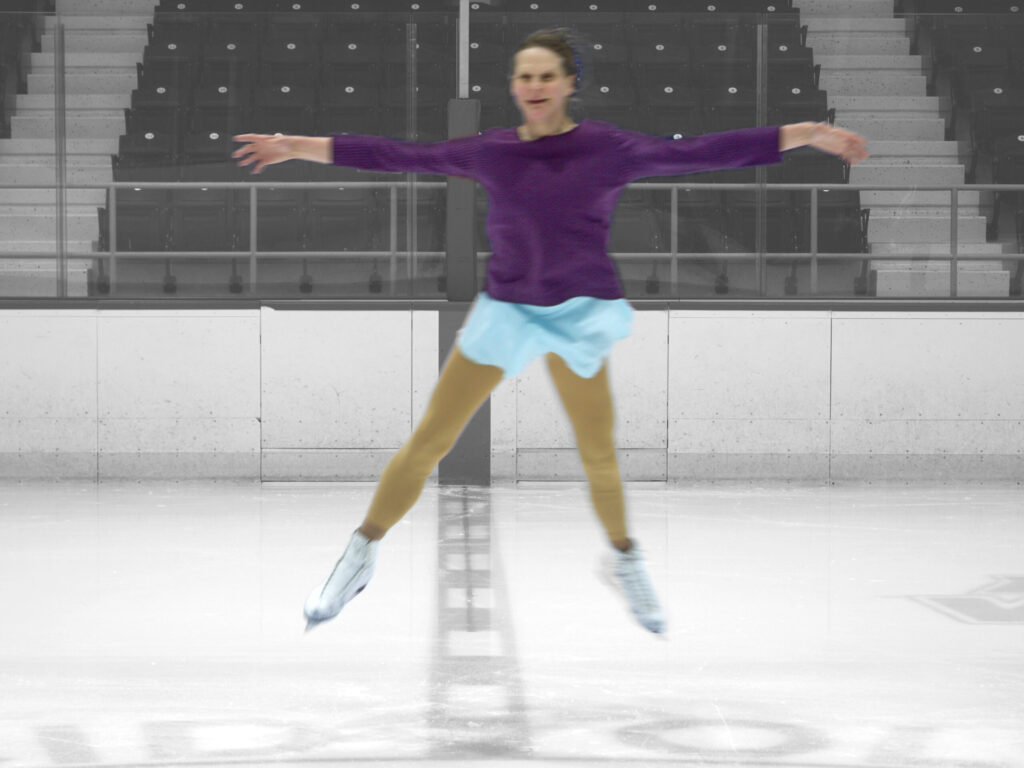
Here we see the end result, a “textbook” waltz jump, frozen mid-air! It is almost identical to the mid-air position in a ballet glissade.

Hold-Move Motion
We can use these ideas of movement quality and “snapshots” not just in waltz jumps, but actually in all of our skating performance. At its core, figure skating consists of two kinds of things we do with our body: first we move our body into a position, and then we hold our body until the next transition to the next position. It may not look like this to the audience because we are always gliding around the ice, often at high speed. But if we ignore the glide and focus on the skater’s body, we come to see a lot more “hold” than we might have imagined at first: because if we do not hold while balancing over a thin blade, we will not be on balance! Each of those holds creates a snapshot for the audience. As we advance, the length of each hold and move becomes shorter and the moves become quicker; but well articulated dance will still have the hold-move quality to it at all times, thereby stretching out the good moments and having us spend as much time as possible on balance. Here is an excellent example of that principle, in the context of the Rhumba ice dance. The skaters repeatedly hold then move; and on each hold, they position their bodies so the next move will seem effortless. The result is a clean, unhurried, well articulated look that is a joy to watch.